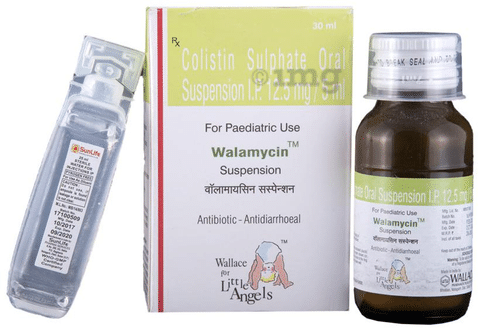
Walamycin
Walamycin Suspension
🇮🇳จำหน่ายในอินเดีย
suspension
ผู้ผลิตWallace Pharmaceuticals Pvt Ltd
แหล่งอ้างอิงเว็บ5 หน้า
สรรพคุณ / การใช้
อาการข้างเคียงที่พบ
ข้อมูลจากเอกสารกำกับยา ไม่ครบถ้วนทุกกรณี — โปรดปรึกษาเภสัชกรสำหรับรายละเอียดเต็ม
ส่วนประกอบ
Colistin Sulphate (12.5mg)
1
Colistin Sulphate
12.5mg
ฐานความรู้
Wikipedia
Colistin
Colistin, also known as polymyxin E, is an antibiotic medication used as a last-resort treatment for multidrug-resistant Gram-negative infections including pneumonia. These may involve bacteria such as Pseudomonas aeruginosa, carbapenem-resistant Klebsiella pneumoniae (CRKP), or Acinetobacter. It comes in two forms: colistimethate sodium can be injected into a vein, injected into a muscle, or inhaled, and colistin sulfate is mainly applied to the skin or taken by mouth. Colistimethate sodium is a prodrug; it is produced by the reaction of colistin with formaldehyde and sodium bisulfite, which leads to the addition of a sulfomethyl group to the primary amines of colistin. Colistimethate sodium is less toxic than colistin when administered parenterally. In aqueous solutions, it undergoes hydrolysis to form a complex mixture of partially sulfomethylated derivatives, as well as colistin. Resistance to colistin began to appear as of 2015.
Colistin หรือที่รู้จักในชื่อ polymyxin E เป็นยาปฏิชีวนะที่ใช้เป็นการรักษาทางเลือกสุดท้ายสำหรับการติดเชื้อแบคทีเรียแกรมลบที่ดื้อต่อยาหลายชนิด รวมถึงปอดอักเสบ การติดเชื้อดังกล่าวอาจเกิดจากแบคทีเรีย เช่น Pseudomonas aeruginosa, Klebsiella pneumoniae ที่ดื้อต่อ carbapenem (CRKP) หรือ Acinetobacter Colistin มีอยู่ 2 รูปแบบ ได้แก่ colistimethate sodium ซึ่งสามารถฉีดเข้าหลอดเลือดดำ ฉีดเข้ากล้ามเนื้อ หรือสูดพ่น และ colistin sulfate ซึ่งส่วนใหญ่ใช้ทาผิวหนังหรือรับประทาน Colistimethate sodium เป็น prodrug ผลิตขึ้นจากปฏิกิริยาระหว่าง colistin กับ formaldehyde และ sodium bisulfite ซึ่งส่งผลให้เกิดการเติมหมู่ sulfomethyl ที่หมู่เอมีนปฐมภูมิของ colistin Colistimethate sodium มีพิษน้อยกว่า colistin เมื่อให้โดยวิธีทางพาเรนเทอรัล ในสารละลายน้ำ colistimethate sodium จะเกิดการ hydrolysis เป็นส่วนผสมที่ซับซ้อนของอนุพันธ์ที่ถูกแทนด้วยหมู่ sulfomethyl บางส่วน รวมถึง colistin ความดื้อต่อ colistin เริ่มปรากฏขึ้นตั้งแต่ปี 2015
Grokipedia
Colistin
Colistin, also known as polymyxin E, is a cationic polypeptide antibiotic derived from the soil bacterium Bacillus polymyxa var. colistinus, renowned for its bactericidal activity against multidrug-resistant (MDR) Gram-negative bacteria.[1] Discovered in Japan in the late 1940s, it was introduced clinically in 1959 but largely abandoned by the 1970s due to high rates of nephro- and neurotoxicity, only to resurge in the late 1990s as a last-resort therapy amid the global crisis of antimicrobial resistance.[2] Administered primarily as its inactive prodrug colistimethate sodium (CMS), which converts to active colistin in vivo, it exhibits a narrow-spectrum action targeting pathogens such as Pseudomonas aeruginosa, Acinetobacter baumannii, and carbapenem-resistant Enterobacteriaceae (CRE), including Klebsiella pneumoniae.[1] Its mechanism involves electrostatic binding to lipopolysaccharides (LPS) in the outer membrane of Gram-negative bacteria, displacing divalent cations like Ca²⁺ and Mg²⁺, which destabilizes the membrane and leads to rapid cell death through permeabilization and leakage of intracellular contents.[1]
Colistin หรือที่รู้จักกันในชื่อ polymyxin E เป็นยาปฏิชีวนะกลุ่มพอลิเปปไทด์ประจุบวก (cationic polypeptide antibiotic) ที่ได้จากแบคทีเรียในดิน Bacillus polymyxa var. colistinus มีชื่อเสียงด้านฤทธิ์ฆ่าเชื้อแบคทีเรีย (bactericidal) ต่อแบคทีเรียแกรมลบที่ดื้อต่อยาหลายชนิด (multidrug-resistant; MDR)[1] ยานี้ถูกค้นพบในประเทศญี่ปุ่นช่วงปลายทศวรรษ 1940 และนำมาใช้ทางคลินิกในปี 1959 แต่ถูกเลิกใช้เป็นส่วนใหญ่ภายในทศวรรษ 1970 เนื่องจากมีอัตราการเกิดพิษต่อไต (nephrotoxicity) และพิษต่อระบบประสาท (neurotoxicity) สูง ก่อนจะกลับมาใช้อีกครั้งในช่วงปลายทศวรรษ 1990 ในฐานะการรักษาทางเลือกสุดท้าย (last-resort therapy) ท่ามกลางวิกฤตการณ์การดื้อยาจุลชีพ (antimicrobial resistance) ทั่วโลก[2] โดยทั่วไปให้ยาในรูปของ prodrug ที่ไม่ออกฤทธิ์คือ colistimethate sodium (CMS) ซึ่งจะถูกเปลี่ยนเป็น colistin ที่ออกฤทธิ์ภายในร่างกาย (in vivo) ยานี้มีสเปกตรัมการออกฤทธิ์แคบ (narrow-spectrum) โดยออกฤทธิ์ต่อเชื้อก่อโรค เช่น Pseudomonas aeruginosa, Acinetobacter baumannii และ Enterobacteriaceae ที่ดื้อต่อ carbapenem (carbapenem-resistant Enterobacteriaceae; CRE) รวมถึง Klebsiella pneumoniae[1] กลไกการออกฤทธิ์เกี่ยวข้องกับการจับแบบสถิตไฟฟ้า (electrostatic binding) กับ lipopolysaccharide (LPS) ในเยื่อหุ้มชั้นนอกของแบคทีเรียแกรมลบ โดยแทนที่ไอออนบวกสองประจุ (divalent cations) เช่น Ca²⁺ และ Mg²⁺ ทำให้เยื่อหุ้มไม่เสถียร และนำไปสู่การตายของเซลล์อย่างรวดเร็วผ่านการเพิ่มความซึมผ่านของเยื่อหุ้ม (permeabilization) และการรั่วไหลของสารภายในเซลล์[1]
แหล่งข้อมูลจากหน้าเว็บ 5
M
Colistin: Antibiotic Uses, Warnings, Side Effects, Dosage
medicinenet.com · อันดับ 1
Health A-Z Diseases & Conditions Procedures & Tests Drugs & Medications RX Drugs & Medications Health & Living Diet & Weight Management Exercise & Fitness Nutri…
R
Colistin: Side Effects, Uses, Dosage, Interactions, Warnings
rxlist.com · อันดับ 2
Drugs & Vitamins Drugs A-Z Generic Drugs A-Z Drugs by Classification Drugs Comparison (Drug Vs. Drug) Drugs and Conditions Vitamins & Supplements Drug Interacti…
U
Colistin Dosing Recommendations and Formulary Guidelines | Department of Internal Medicine | University of Nebraska Medical Center
unmc.edu · อันดับ 3
By continuing to browse our website, you agree to the storing of first- and third-party cookies and related technologies on your device to enhance site access a…
P
Colistin | C52H98N16O13 | CID 5311054 - PubChem
pubchem.ncbi.nlm.nih.gov · อันดับ 4
An official website of the United States government Here is how you know NIH National Library of Medicine NCBI R PubChem About Docs Submit Contact Theme Setting…
S
Colistin - an overview | ScienceDirect Topics
sciencedirect.com · อันดับ 5
Skip to Main content Journals & Books Help Search My account Sign in Colistin In subject area: Immunology and Microbiology Also in subject areas / Show all Agri…