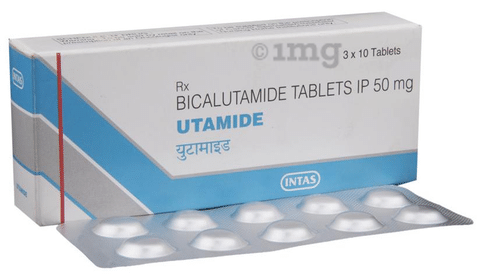
Utamide
Utamide Tablet
🇮🇳จำหน่ายในอินเดีย
tablet
ผู้ผลิตIntas Pharmaceuticals Ltd
แหล่งอ้างอิงเว็บ5 หน้า
สรรพคุณ / การใช้
อาการข้างเคียงที่พบ
ข้อมูลจากเอกสารกำกับยา ไม่ครบถ้วนทุกกรณี — โปรดปรึกษาเภสัชกรสำหรับรายละเอียดเต็ม
ส่วนประกอบ
Bicalutamide (50mg)
1
Bicalutamide
50mg
ฐานความรู้
Wikipedia
Bicalutamide
Bicalutamide, sold under the brand name Casodex among others, is an antiandrogen medication that is primarily used to treat prostate cancer. It is typically used together with a gonadotropin-releasing hormone (GnRH) analogue or surgical removal of the testicles to treat metastatic prostate cancer (mPC). To a lesser extent, it is used at high doses for locally advanced prostate cancer (LAPC) as a monotherapy without castration. Bicalutamide was also previously used as monotherapy to treat localized prostate cancer (LPC), but authorization for this use was withdrawn following unfavorable trial findings. Besides prostate cancer, bicalutamide is limitedly used in the treatment of excessive hair growth and scalp hair loss in women, as a puberty blocker and component of feminizing hormone therapy for transgender girls and women, to treat gonadotropin-independent early puberty in boys, and to prevent overly long-lasting erections in men. It is taken by mouth.
Bicalutamide ซึ่งวางจำหน่ายภายใต้ชื่อการค้า Casodex และชื่ออื่น ๆ เป็นยาต้านแอนโดรเจน (antiandrogen) ที่ใช้เป็นหลักในการรักษามะเร็งต่อมลูกหมาก โดยทั่วไปใช้ร่วมกับสารคล้ายฮอร์โมนปลดปล่อยโกนาโดโทรปิน (gonadotropin-releasing hormone; GnRH) หรือการผ่าตัดเอาอัณฑะออก เพื่อรักษามะเร็งต่อมลูกหมากที่แพร่กระจาย (metastatic prostate cancer; mPC) และในระดับที่น้อยกว่า ใช้ในขนาดสูงเพื่อรักษามะเร็งต่อมลูกหมากระยะลุกลามเฉพาะที่ (locally advanced prostate cancer; LAPC) โดยใช้เป็นยาเดี่ยว (monotherapy) โดยไม่ทำการตัดอัณฑะ (castration) Bicalutamide เคยถูกใช้เป็นยาเดี่ยวเพื่อรักษามะเร็งต่อมลูกหมากระยะเฉพาะที่ (localized prostate cancer; LPC) มาก่อน แต่การอนุญาตสำหรับการใช้ดังกล่าวถูกถอนคืนหลังจากพบผลการศึกษาทางคลินิกที่ไม่เป็นที่น่าพึงพอใจ นอกเหนือจากมะเร็งต่อมลูกหมาก Bicalutamide ยังถูกใช้อย่างจำกัดในการรักษาภาวะมีขนมากผิดปกติ (hirsutism) และภาวะผมร่วงบนหนังศีรษะในสตรี ใช้เป็นยาหน่วงวัยแรกรู้สึก (puberty blocker) และเป็นองค์ประกอบหนึ่งของการบำบัดด้วยฮอร์โมนเพื่อสร้างลักษณะหญิง (feminizing hormone therapy) ในเด็กหญิงข้ามเพศและสตรีข้ามเพศ ใช้รักษาภาวะวัยแรกรู้สึกก่อนวัยแบบไม่ขึ้นกับโกนาโดโทรปิน (gonadotropin-independent early puberty) ในเด็กชาย และใช้ป้องกันภาวะองคชาตแข็งตัวนานผิดปกติ (priapism) ในผู้ชาย ยานี้ให้โดยการรับประทาน
Grokipedia
Bicalutamide
Bicalutamide is a nonsteroidal antiandrogen medication that acts as a competitive inhibitor of androgen receptors, primarily used in combination with luteinizing hormone-releasing hormone (LHRH) analogs to treat stage D2 metastatic prostate cancer.[1] Developed as a nonsteroidal antiandrogen, it was first approved by the U.S. Food and Drug Administration (FDA) in 1995 under the brand name Casodex for oral administration in 50 mg tablets.[1] The drug's active R-enantiomer binds to cytosol androgen receptors in target tissues, preventing the normal androgen-induced effects that promote prostate cancer cell growth and survival, while exhibiting minimal agonistic activity compared to earlier antiandrogens like flutamide.[1][2]
Bicalutamide เป็นยาต้านแอนโดรเจนที่ไม่ใช่สเตียรอยด์ ซึ่งออกฤทธิ์เป็นตัวยับยั้งตัวรับแอนโดรเจนแบบแข่งขัน (competitive inhibitor) ใช้ร่วมกับสารคล้ายฮอร์โมนปลดปล่อยฮอร์โมนลูทีไนซิง (luteinizing hormone-releasing hormone; LHRH) เป็นหลักในการรักษามะเร็งต่อมลูกหมากระยะแพร่กระจาย D2[1] ยานี้ได้รับการพัฒนาให้เป็นยาต้านแอนโดรเจนที่ไม่ใช่สเตียรอยด์ และได้รับการรับรองครั้งแรกจากสำนักงานคณะกรรมการอาหารและยาสหรัฐอเมริกา (U.S. Food and Drug Administration; FDA) ในปี ค.ศ. 1995 ภายใต้ชื่อการค้า Casodex สำหรับการให้ทางปากในรูปแบบยาเม็ดขนาด 50 mg[1] อีแนนทิโอเมอร์ R ซึ่งเป็นส่วนที่ออกฤทธิ์ของยา จะจับกับตัวรับแอนโดรเจนในไซโทซอล (cytosol) ของเนื้อเยื่อเป้าหมาย ทำให้ป้องกันผลที่เกิดจากแอนโดรเจนตามปกติซึ่งส่งเสริมการเจริญเติบโตและการอยู่รอดของเซลล์มะเร็งต่อมลูกหมาก โดยมีฤทธิ์แบบอะโกนิสต์ (agonistic activity) น้อยที่สุดเมื่อเทียบกับยาต้านแอนโดรเจนรุ่นก่อนหน้า เช่น flutamide[1][2]
แหล่งข้อมูลจากหน้าเว็บ 5
M
Bicalutamide (oral route) - Side effects & dosage - Mayo Clinic
mayoclinic.org · อันดับ 1
Skip to content Care at Mayo Clinic Health Library For Medical Professionals Research & Education at Mayo Clinic Giving to Mayo Clinic Request appointment Regis…
W
Bicalutamide (Casodex): Uses, Side Effects, Interactions, Pictures, Warnings & Dosing - WebMD
webmd.com · อันดับ 2
Skip to main content Conditions Drugs & Supplements Well-Being Symptom Checker Find a Doctor More Subscribe Log In Drugs & SupplementsBicalutamide (Casodex) Bic…
C
Bicalutamide - NCI
cancer.gov · อันดับ 3
Skip to main content An official website of the United States government Search Search About Cancer Cancer Types Research Grants & Training News & Events About …
M
Bicalutamide: MedlinePlus Drug Information
medlineplus.gov · อันดับ 4
Skip navigation An official website of the United States government Here’s how you know National Library of Medicine Search MedlinePlus GO About MedlinePlusWhat…
R
Bicalutamide: Side Effects, Uses, Dosage, Interactions, Warnings
rxlist.com · อันดับ 5
Drugs & Vitamins Drugs A-Z Generic Drugs A-Z Drugs by Classification Drugs Comparison (Drug Vs. Drug) Drugs and Conditions Vitamins & Supplements Drug Interacti…