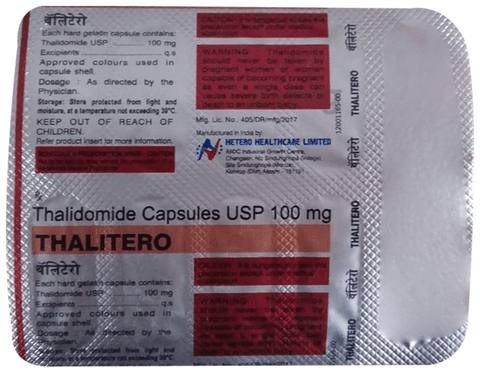
Thalitero
Thalitero Capsule
🇮🇳จำหน่ายในอินเดีย
capsule
ผู้ผลิตHetero Drugs Ltd
แหล่งอ้างอิงเว็บ1 หน้า
สรรพคุณ / การใช้
อาการข้างเคียงที่พบ
ข้อมูลจากเอกสารกำกับยา ไม่ครบถ้วนทุกกรณี — โปรดปรึกษาเภสัชกรสำหรับรายละเอียดเต็ม
ส่วนประกอบ
Thalidomide (100mg)
1
Thalidomide
100mg
ฐานความรู้
Wikipedia
Thalidomide
Thalidomide, sold under the brand names Contergan, Distaval and Thalomid among others, is an oral administered medication currently used to treat a number of cancers, graft-versus-host disease, and many skin disorders. Thalidomide has been used to treat conditions associated with HIV: aphthous ulcers, HIV-associated wasting syndrome, diarrhea, and Kaposi's sarcoma, but increases in HIV viral load have been reported.
Thalidomide ซึ่งจำหน่ายภายใต้ชื่อการค้า Contergan, Distaval และ Thalomid รวมถึงชื่ออื่น ๆ เป็นยาสำหรับรับประทานที่ปัจจุบันใช้รักษามะเร็งหลายชนิด โรคต่อต้านเนื้อเยื่อของผู้บริจาค (graft-versus-host disease) และโรคผิวหนังหลายชนิด Thalidomide เคยถูกใช้เพื่อรักษาภาวะที่เกี่ยวข้องกับ HIV ได้แก่ แผลร้อนใน (aphthous ulcers) กลุ่มอาการเสียสารอาหารที่เกี่ยวข้องกับ HIV (HIV-associated wasting syndrome) อาการท้องเสีย และ Kaposi's sarcoma แต่มีรายงานว่าอาจทำให้ปริมาณไวรัส HIV (viral load) เพิ่มขึ้น
Grokipedia
Thalidomide
Thalidomide is a synthetic glutarimide derivative initially developed in the early 1950s by the West German pharmaceutical company Chemie Grünenthal as a sedative and hypnotic agent lacking the toxicity associated with barbiturates.[1] Marketed under names such as Contergan and Distaval starting in 1957 across Europe, Australia, and other regions, it was promoted for treating insomnia and, crucially, nausea and vomiting in pregnancy, with claims of safety for use by pregnant women based on limited animal testing that failed to reveal its teratogenic potential.[2] Between 1957 and 1962, widespread use by pregnant women resulted in over 10,000 cases of severe congenital malformations, predominantly phocomelia—a condition characterized by shortened or absent limbs—along with damage to eyes, ears, gastrointestinal, and cardiovascular systems, occurring when the drug was ingested during a narrow 20- to 36-day window post-fertilization when embryonic limb buds form.[2][3] The causal link was established through epidemiological investigations, notably by Australian obstetrician William McBride and others, prompting swift market withdrawals by 1961-1962 and catalyzing rigorous global drug safety regulations, including mandatory efficacy and safety proofs.[2] Despite this catastrophe, thalidomide's immunomodulatory and anti-angiogenic properties—later elucidated via inhibition of tumor necrosis factor-alpha and cereblon-mediated protein degradation—led to its repurposing in the 1980s-