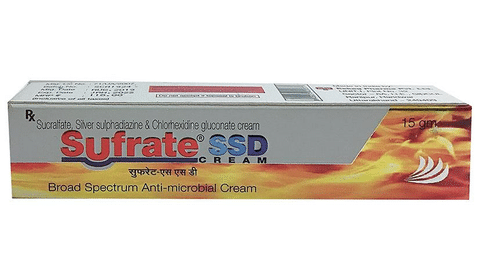
Sufrate Ssd
Sufrate Ssd Cream
🇮🇳จำหน่ายในอินเดีย
cream
ผู้ผลิตEskag Pharma Pvt Ltd
แหล่งอ้างอิงเว็บ3 หน้า
สรรพคุณ / การใช้
อาการข้างเคียงที่พบ
ข้อมูลจากเอกสารกำกับยา ไม่ครบถ้วนทุกกรณี — โปรดปรึกษาเภสัชกรสำหรับรายละเอียดเต็ม
ส่วนประกอบ
Sucralfate (7% w/w) + Silver Sulfadiazine (1% w/w) + Chlorhexidine Gluconate (0.20% w/w)
1
Sucralfate
7% w/w
2
Silver Sulfadiazine
1% w/w
3
Chlorhexidine Gluconate
0.20% w/w
ฐานความรู้
Wikipedia
Silver sulfadiazine
Silver sulfadiazine, sold under the brand Silvadene among others, is a topical antibiotic used in partial thickness (second-degree) and full thickness (third-degree) burns to prevent infection. Tentative evidence has found other antibiotics to be more effective, and therefore it is no longer generally recommended for second-degree burns, but is still widely used to protect third-degree burns.
Silver sulfadiazine จำหน่ายภายใต้ชื่อการค้า Silvadene และอื่น ๆ เป็นยาปฏิชีวนะสำหรับใช้ภายนอก ใช้ในแผลไหม้ชั้นผิวหนังบางส่วน (partial thickness; ไหม้ระดับที่สอง) และแผลไหม้ชั้นผิวหนังทุกชั้น (full thickness; ไหม้ระดับที่สาม) เพื่อป้องกันการติดเชื้อ หลักฐานเบื้องต้นพบว่ายาปฏิชีวนะชนิดอื่นมีประสิทธิภาพมากกว่า จึงไม่แนะนำโดยทั่วไปสำหรับแผลไหม้ระดับที่สองอีกต่อไป แต่ยังคงใช้กันอย่างแพร่หลายเพื่อปกป้องแผลไหม้ระดับที่สาม
Grokipedia
Silver sulfadiazine
Silver sulfadiazine is a topical antimicrobial medication combining the sulfonamide antibiotic sulfadiazine with silver ions, formulated as a 1% cream for application to the skin.[1] It is primarily indicated as an adjunct for the prevention and treatment of wound sepsis in patients with second- and third-degree burns, where it provides broad-spectrum bactericidal activity against many gram-positive and gram-negative bacteria, as well as some yeasts, including resistant strains like Pseudomonas aeruginosa.[2] Approved by the U.S. Food and Drug Administration in 1973, it has been a standard therapy for burn wound management due to its affordability, tolerability, and ability to reduce infection risk, though it may delay wound re-epithelialization and form a pseudoeschar layer.[3]
แหล่งข้อมูลจากหน้าเว็บ 3
W
Silver sulfadiazine topical: Uses, Side Effects & More (Silvadene, SSD)
webmd.com · อันดับ 1
Silver sulfadiazine is a topical sulfa antibiotic, prescription-only, available as a generic. Common brand names: Silvadene, SSD, Thermazene. Dosage form is a 1…
M
Silver Sulfadiazine: MedlinePlus Drug Information
medlineplus.gov · อันดับ 2
Silver sulfadiazine is a sulfa drug that works against bacteria. It is used to prevent and treat infections of second- and third-degree burns. It kills a wide v…
G
Silver sulfadiazine cream (Silvadene cream): Uses, Side Effects, FAQs & More
goodrx.com · อันดับ 3
Silver sulfadiazine (SSD) is an antibiotic cream used to treat or prevent serious skin infections caused by second- or third-degree burns. It is typically appli…