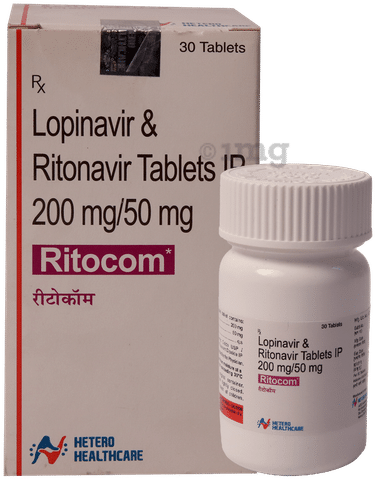
Ritocom
Ritocom 50 mg/200 mg Tablet
🇮🇳จำหน่ายในอินเดีย
tablet
ผู้ผลิตHetero Drugs Ltd
แหล่งอ้างอิงเว็บ3 หน้า
สรรพคุณ / การใช้
อาการข้างเคียงที่พบ
ข้อมูลจากเอกสารกำกับยา ไม่ครบถ้วนทุกกรณี — โปรดปรึกษาเภสัชกรสำหรับรายละเอียดเต็ม
ส่วนประกอบ
Ritonavir (50mg) + Lopinavir (200mg)
1
Ritonavir
50mg
2
Lopinavir
200mg
ฐานความรู้
Wikipedia
Ritonavir
Ritonavir, sold under the brand name Norvir, is an antiretroviral medication used along with other medications to treat HIV/AIDS. This combination treatment is known as highly active antiretroviral therapy (HAART). Ritonavir is a protease inhibitor, though it now mainly serves to boost the potency of other protease inhibitors. It may also be used in combination with other medications to treat hepatitis C and COVID-19. It is taken by mouth.
Ritonavir จำหน่ายภายใต้ชื่อการค้า Norvir เป็นยาต้านไวรัส (antiretroviral) ใช้ร่วมกับยาอื่น ๆ เพื่อรักษาโรค HIV/AIDS การรักษาแบบใช้ยาร่วมกันนี้เรียกว่า การรักษาด้วยยาต้านไวรัสที่ออกฤทธิ์สูง (highly active antiretroviral therapy; HAART) Ritonavir จัดเป็นยายับยั้งเอนไซม์โปรตีเอส (protease inhibitor) แต่ปัจจุบันส่วนใหญ่ใช้เพื่อเพิ่มประสิทธิภาพของยายับยั้งเอนไซม์โปรตีเอสชนิดอื่น ๆ นอกจากนี้ยังอาจใช้ร่วมกับยาอื่น ๆ เพื่อรักษาโรคตับอักเสบซี (hepatitis C) และโควิด-19 (COVID-19) มีเส้นทางการให้ยาโดยการรับประทาน
Grokipedia
Ritonavir
Ritonavir is a synthetic antiretroviral medication classified as a protease inhibitor, primarily utilized in the management of human immunodeficiency virus (HIV) infection. Developed by Abbott Laboratories, it was approved by the U.S. Food and Drug Administration in 1996 as part of combination therapy to suppress viral replication by targeting the HIV-1 protease enzyme essential for viral maturation.[1][2] Due to its potent inhibition of the cytochrome P450 3A4 (CYP3A4) enzyme, ritonavir is frequently administered at low doses as a pharmacokinetic enhancer, or "booster," to increase the bioavailability and prolong the half-life of co-administered protease inhibitors and other antiretrovirals, thereby improving treatment efficacy and reducing dosing frequency.[3][4]
แหล่งข้อมูลจากหน้าเว็บ 3
N
Ritonavir - StatPearls - NCBI Bookshelf
ncbi.nlm.nih.gov · อันดับ 1
Ritonavir is a protease inhibitor approved by the FDA in 1996 to treat HIV — the second protease inhibitor approved in the US after saquinavir (StatPearls, last…
C
Ritonavir (Patient Drug Record) | NIH ClinicalInfo HIV.gov
clinicalinfo.hiv.gov · อันดับ 2
Ritonavir (brand name: Norvir) is a prescription medicine approved by the U.S. Food and Drug Administration (FDA) for treating HIV in adults and children. Other…
A
Ritonavir (RTV, Norvir) | aidsmap
aidsmap.com · อันดับ 3
Ritonavir (RTV, brand name Norvir) — aidsmap factsheet, Keith Alcorn, September 2021. Ritonavir was among the first protease inhibitors developed, but is no lon…