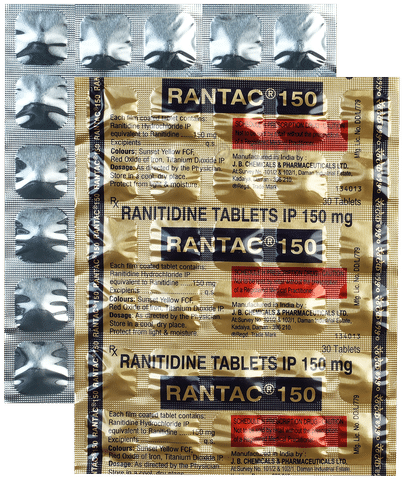
Rantac 150
Rantac 150 Tablet
🇮🇳จำหน่ายในอินเดีย
tablet
ผู้ผลิตJ B Chemicals and Pharmaceuticals Ltd
แหล่งอ้างอิงเว็บ3 หน้า
สรรพคุณ / การใช้
อาการข้างเคียงที่พบ
ข้อมูลจากเอกสารกำกับยา ไม่ครบถ้วนทุกกรณี — โปรดปรึกษาเภสัชกรสำหรับรายละเอียดเต็ม
ส่วนประกอบ
Ranitidine (150mg)
1
Ranitidine
150mg
ฐานความรู้
Wikipedia
Ranitidine
Ranitidine, sold under the brand name Zantac among others, is a medication used to decrease stomach acid production. It is used in the treatment of peptic ulcer disease, gastroesophageal reflux disease, and Zollinger–Ellison syndrome. It can be given by mouth, injection into a muscle, or injection into a vein.
Ranitidine วางจำหน่ายภายใต้ชื่อการค้า Zantac และชื่ออื่น ๆ เป็นยาที่ใช้ลดการหลั่งกรดในกระเพาะอาหาร ใช้สำหรับรักษาโรคแผลในกระเพาะอาหารและลำไส้เล็กส่วนต้น (peptic ulcer disease) โรคกรดไหลย้อนจากกระเพาะอาหารขึ้นหลอดอาหาร (gastroesophageal reflux disease) และกลุ่มอาการซอลลินเจอร์-เอลลิสัน (Zollinger–Ellison syndrome) สามารถให้ยาได้โดยการรับประทาน ฉีดเข้ากล้ามเนื้อ หรือฉีดเข้าหลอดเลือดดำ
Grokipedia
Ranitidine
Ranitidine is a histamine H₂-receptor antagonist that competitively inhibits the action of histamine on gastric parietal cells, thereby reducing gastric acid secretion and treating conditions such as peptic ulcers, gastroesophageal reflux disease, and Zollinger-Ellison syndrome.[1][2] Developed by Glaxo Laboratories as a successor to cimetidine with greater potency and fewer drug interactions, it was approved for prescription use in the United Kingdom in 1981 and the United States in 1983 under the brand name Zantac, rapidly becoming a blockbuster drug that generated peak annual sales exceeding $2 billion by the early 1990s due to its efficacy in ulcer healing and acid suppression, as demonstrated in clinical trials showing superior relapse prevention compared to placebo.[3][2] Marketed initially by prescription and later over-the-counter, ranitidine's dominance waned with the advent of proton pump inhibitors offering deeper acid suppression, though meta-analyses confirmed its effectiveness in short-term duodenal ulcer healing rates around 70-80% at four weeks.[4][5] Its legacy was marred by revelations in 2019 of N-nitrosodimethylamine (NDMA) contamination—a probable carcinogen formed via ranitidine degradation under heat and time—prompting FDA requests for manufacturer-led recalls and eventual market withdrawal in 2020, as NDMA levels exceeded acceptable intake limits (96 ng/day) in stability-tested samples, though cohort studies have not consistently linked typical use to
แหล่งข้อมูลจากหน้าเว็บ 3
M
Ranitidine: MedlinePlus Drug Information
medlineplus.gov · อันดับ 1
Ranitidine is in a class of medications called H2 blockers. It decreases the amount of acid made in the stomach. Used to treat ulcers; gastroesophageal reflux d…
N
Ranitidine: medicine that lowers stomach acid - NHS
nhs.uk · อันดับ 2
Ranitidine is not currently available in the UK or globally. It was discontinued as a precaution because it may contain a small amount of an impurity (NDMA) tha…
G
Ranitidine: Uses, Side Effects, Interactions - GoodRx
goodrx.com · อันดับ 3
Ranitidine (generic Zantac) is a histamine-2 (H2) antagonist that lowers acid made by cells in the stomach lining, relieving heartburn and allowing ulcers to he…