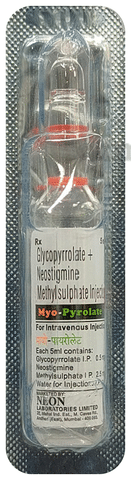
Myo Pyrolate
Myo Pyrolate Injection
🇮🇳จำหน่ายในอินเดีย
injection
ผู้ผลิตNeon Laboratories Ltd
แหล่งอ้างอิงเว็บ2 หน้า
สรรพคุณ / การใช้
อาการข้างเคียงที่พบ
ข้อมูลจากเอกสารกำกับยา ไม่ครบถ้วนทุกกรณี — โปรดปรึกษาเภสัชกรสำหรับรายละเอียดเต็ม
ส่วนประกอบ
Glycopyrrolate (0.5mg) + Neostigmine (2.5mg)
1
Glycopyrrolate
0.5mg
2
Neostigmine
2.5mg
ฐานความรู้
Wikipedia
Neostigmine
Neostigmine, sold under the brand name Bloxiverz, among others, is a medication used to treat myasthenia gravis, Ogilvie syndrome, and urinary retention without the presence of a blockage. It is also used in anaesthesia to end the effects of non-depolarising neuromuscular blocking medication. It is given by injection either into a vein, muscle, or under the skin. After injection effects are generally greatest within 30 minutes and last up to 4 hours.
Neostigmine จำหน่ายภายใต้ชื่อการค้า Bloxiverz และชื่ออื่น ๆ เป็นยาที่ใช้รักษาโรคกล้ามเนื้ออ่อนแรง (myasthenia gravis), กลุ่มอาการ Ogilvie (Ogilvie syndrome) และภาวะปัสสาวะค้างโดยไม่มีการอุดกั้น นอกจากนี้ยังใช้ในการระงับความรู้สึก (anaesthesia) เพื่อยุติฤทธิ์ของยาคลายกล้ามเนื้อกลุ่ม non-depolarising neuromuscular blocking medication ยานี้ให้โดยการฉีดเข้าหลอดเลือดดำ เข้ากล้ามเนื้อ หรือใต้ผิวหนัง หลังการฉีด ฤทธิ์ยาโดยทั่วไปจะออกฤทธิ์สูงสุดภายใน 30 นาที และออกฤทธิ์ได้นานถึง 4 ชั่วโมง
Grokipedia
Neostigmine
Neostigmine is a synthetic, water-soluble quaternary ammonium compound that functions as a reversible acetylcholinesterase inhibitor, primarily used to reverse the effects of non-depolarizing neuromuscular blocking agents after surgery and in the diagnosis and symptomatic treatment of myasthenia gravis.[1][2] It is administered via intravenous, intramuscular, oral, or subcutaneous routes, with typical dosing for neuromuscular reversal ranging from 0.03 to 0.07 mg/kg intravenously, often in combination with an antimuscarinic agent like glycopyrrolate to mitigate cholinergic side effects.[2] Originally synthesized in the 1930s, neostigmine has become a cornerstone in anesthesiology and neurology due to its ability to enhance cholinergic transmission without crossing the blood-brain barrier.[2]
แหล่งข้อมูลจากหน้าเว็บ 2
N
Neostigmine - StatPearls (NCBI Bookshelf)
ncbi.nlm.nih.gov · อันดับ 1
Neostigmine (Neely GA, Sabir S, Kohli A. StatPearls, updated Jan 19, 2025). An ionized water-soluble compound that reversibly inhibits the enzyme acetylcholines…
P
Neostigmine - Pediatric Oncall Drug Index
pediatriconcall.com · อันดับ 2
Neostigmine - acetylcholinesterase inhibitor: Neostigmine inhibits the hydrolysis of acetylcholine by competing with acetylcholine for attachment to acetylcholi…