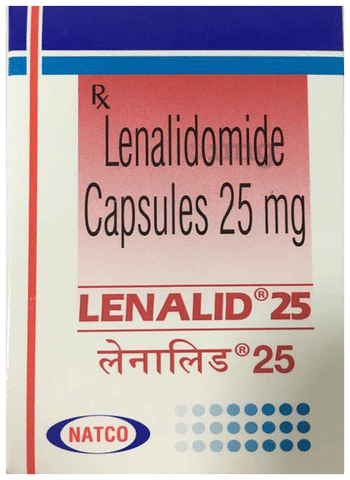
Lenalid 25
Lenalid 25 Capsule
🇮🇳จำหน่ายในอินเดีย
capsule
ผู้ผลิตNatco Pharma Ltd
แหล่งอ้างอิงเว็บ5 หน้า
สรรพคุณ / การใช้
อาการข้างเคียงที่พบ
ข้อมูลจากเอกสารกำกับยา ไม่ครบถ้วนทุกกรณี — โปรดปรึกษาเภสัชกรสำหรับรายละเอียดเต็ม
ส่วนประกอบ
Lenalidomide (25mg)
1
Lenalidomide
25mg
ฐานความรู้
Wikipedia
Lenalidomide
Lenalidomide, sold under the brand name Revlimid among others, is a medication used to treat multiple myeloma, smoldering myeloma, various indolent lymphomas, and myelodysplastic syndromes (MDS). For multiple myeloma, it is a first-line treatment, and is given with dexamethasone. It is taken by mouth.
Lenalidomide ซึ่งวางจำหน่ายภายใต้ชื่อการค้า Revlimid และชื่ออื่น ๆ เป็นยาที่ใช้รักษามัลติเปิลไมโอมา (multiple myeloma), ไมอีโลมาชนิด smoldering, มะเร็งต่อมน้ำเหลืองชนิด indolent หลายชนิด และกลุ่มอาการไมอีโลไดส์พลาสติก (myelodysplastic syndromes; MDS) สำหรับมัลติเปิลไมโอมา ถือเป็นการรักษาลำดับแรก (first-line treatment) โดยให้ร่วมกับ dexamethasone ยานี้ใช้โดยการรับประทาน
Grokipedia
Lenalidomide
Lenalidomide is a thalidomide-derived oral immunomodulatory agent with antineoplastic properties, primarily indicated for the treatment of multiple myeloma in newly diagnosed, relapsed, or refractory settings, as well as maintenance therapy following autologous stem cell transplantation, and for transfusion-dependent anemia in patients with low- or intermediate-1-risk myelodysplastic syndromes associated with a deletion 5q cytogenetic abnormality.[1][2] First approved by the U.S. Food and Drug Administration in December 2005 for the myelodysplastic syndrome indication, its approvals expanded through subsequent clinical trials demonstrating prolonged progression-free survival and overall survival in multiple myeloma patients compared to placebo or alternative therapies.[3][4] Lenalidomide exerts its effects by binding to the E3 ubiquitin ligase cereblon, promoting the proteasomal degradation of transcription factors such as Ikaros and Aiolos, which inhibits cancer cell proliferation, enhances T-cell and natural killer cell-mediated cytotoxicity, and suppresses pro-inflammatory cytokines in the tumor microenvironment.[5] In multiple myeloma, combination regimens with dexamethasone or bortezomib have yielded overall response rates exceeding 60% in relapsed patients and significantly improved three-year progression-free survival rates to approximately 53% versus 36% with controls.[6][7] Despite its efficacy, lenalidomide carries substantial risks, including severe neutropenia, th
แหล่งข้อมูลจากหน้าเว็บ 5
R
REVLIMID® (lenalidomide) - Official Patient Website
revlimid.com · อันดับ 1
This site is intended for US audiences only. Indication REVLIMID® (lenalidomide) is a prescription medicine, used to treat adults with multiple myeloma (MM) in …
M
Lenalidomide (oral route) - Side effects & dosage - Mayo Clinic
mayoclinic.org · อันดับ 2
Skip to content Care at Mayo Clinic Health Library For Medical Professionals Research & Education at Mayo Clinic Giving to Mayo Clinic Request appointment Regis…
C
Lenalidomide - NCI
cancer.gov · อันดับ 3
Skip to main content An official website of the United States government Search Search About Cancer Cancer Types Research Grants & Training News & Events About …
W
Lenalidomide (Revlimid): Uses, Side Effects, Interactions, Pictures, Warnings & Dosing - WebMD
webmd.com · อันดับ 4
Skip to main content Conditions Drugs & Supplements Well-Being Symptom Checker Find a Doctor More Subscribe Log In Drugs & Supplements Lenalidomide (Revlimid) L…
M
Lenalidomide: MedlinePlus Drug Information
medlineplus.gov · อันดับ 5
Skip navigation An official website of the United States government Here’s how you know National Library of Medicine Search MedlinePlus GO About MedlinePlusWhat…