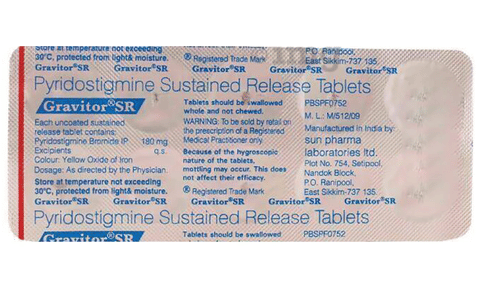
Gravitor SR
Gravitor SR Tablet
🇮🇳จำหน่ายในอินเดีย
tablet
สรรพคุณ / การใช้
อาการข้างเคียงที่พบ
ข้อมูลจากเอกสารกำกับยา ไม่ครบถ้วนทุกกรณี — โปรดปรึกษาเภสัชกรสำหรับรายละเอียดเต็ม
ส่วนประกอบ
Pyridostigmine (180mg)
1
Pyridostigmine
180mg
ฐานความรู้
Wikipedia
Pyridostigmine
Pyridostigmine is a medication used to treat myasthenia gravis and underactive bladder. It is also used together with atropine to end the effects of neuromuscular blocking medication of the non-depolarizing type. It is also used off-label to treat some forms of Postural orthostatic tachycardia syndrome.
Pyridostigmine เป็นยาที่ใช้รักษาภาวะกล้ามเนื้ออ่อนแรงชนิดร้าย (myasthenia gravis) และภาวะกระเพาะปัสสาวะอ่อนแรง (underactive bladder) นอกจากนี้ยังใช้ร่วมกับ atropine เพื่อยุติฤทธิ์ของยาคลายกล้ามเนื้อชนิดระงับการทำงานของเส้นประสาทและกล้ามเนื้อแบบไม่ทำให้เกิด depolarization (non-depolarizing type) และยังใช้นอกเหนือจากที่ระบุในเอกสารกำกับยา (off-label) เพื่อรักษารูปแบบบางชนิดของภาวะหัวใจเต้นเร็วเมื่อเปลี่ยนท่าจากนอนเป็นยืน (postural orthostatic tachycardia syndrome)
Grokipedia
Pyridostigmine
Pyridostigmine bromide is a synthetic quaternary ammonium carbamate compound that functions as a reversible inhibitor of the enzyme acetylcholinesterase, thereby increasing acetylcholine levels at neuromuscular junctions to improve muscle strength in conditions characterized by deficient transmission.[1][2] It is chemically designated as 3-[(dimethylcarbamoyl)oxy]-1-methylpyridinium bromide, with the molecular formula C₉H₁₃BrN₂O₂, and was first synthesized in 1945 by Hoffman-La Roche Laboratories.[3][4]